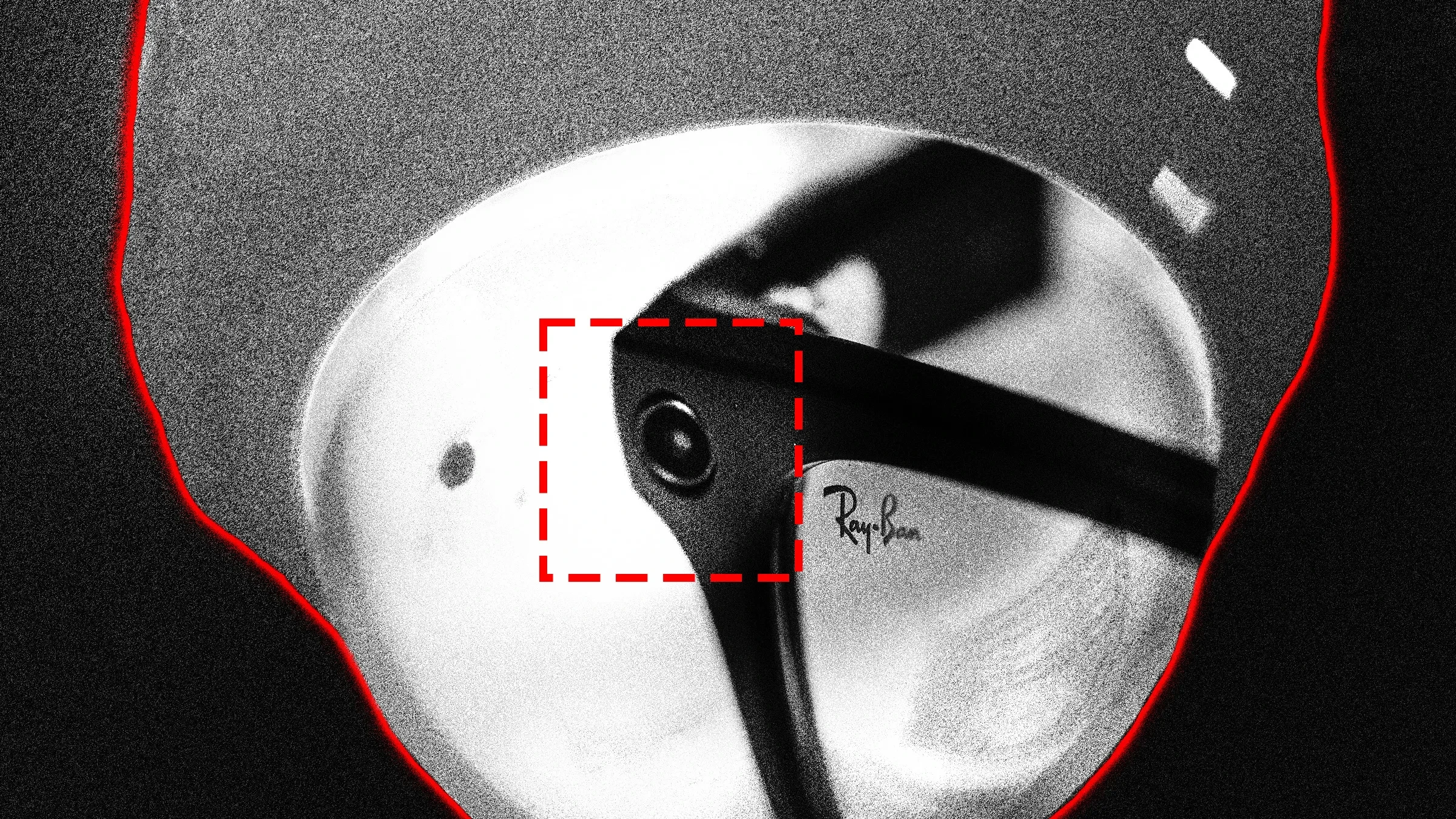
Exclusive: Meta Testing Law Enforcement-Grade Facial Recognition From Surveillance Vendor For Smart Glasses, WIRED Has Learned
Meta is testing facial recognition technology developed by a vendor that supplies surveillance tools to U.S. law enforcement and the American military, as the company explores adding the capability to its line of consumer smart glasses, WIRED can reveal.
The business arrangement between the two firms is documented in a software license obtained and reviewed by WIRED, issued by Denver-based Rank One Computing. Roughly 80% of Rank One’s total revenue comes from government clients, and the license is tied to a test build of the Meta AI app that powers Meta’s Ray-Ban and Oakley branded smart glasses.
Rank One’s facial recognition tools are already widely used across U.S. government agencies: The U.S. Marshals Service relies on the technology to confirm prisoner identities during transit without requiring fingerprint scans, while the Naval Criminal Investigative Service (NCIS), the Navy’s law enforcement arm, purchased the company’s ROC Watch video analytics tool. Under a federal research contract, Rank One also developed long-range facial recognition for U.S. Special Operations Command, advertising that its software can accurately identify a face from distances of up to one kilometer. Police departments across the country also use the company’s algorithms, embedded in surveillance tools sold by third-party vendors.
This license marks the first publicly confirmed evidence of a relationship between Meta and Rank One, and it offers a rare look at the type of technology Meta is weighing for a mass-market consumer device. It also underscores just how thin the line has grown between surveillance technology built for law enforcement and the military, and consumer products sold to the general public. Increasingly, the same companies and the same core algorithms serve both sectors.
The license Meta acquired authorizes use of Rank One’s facial recognition alongside its liveness detection tool, a feature that verifies a camera is capturing a live person rather than a static photo or fake mask. It supports up to 10 million facial templates and remains active. A review of app code by WIRED found that leftover remnants of Rank One’s integration — including routines to load the license and initialize the company’s software — remained dormant in a version of Meta’s app shipped to millions of consumers this month, sitting alongside Meta’s own in-house facial recognition system.
None of the facial recognition systems tied to Meta’s smart glasses have ever been active for end users. Meta deleted all of this code from the app entirely on June 5, one day after WIRED revealed the company had quietly built an unreleased internal facial recognition system, codenamed NameTag, into the Meta AI smart glasses companion app — software downloaded by more than 50 million mobile users. That internal system was also dormant and inaccessible to regular users.
Meta declined to answer nearly all questions about its arrangement with Rank One, refusing to comment on why it licensed the software, when the business relationship began, or whether it is still ongoing. Rank One also declined to comment for this story.
| Got a Tip? |
|---|
| Are you a current or former Meta employee with insight into the company’s technology development? We want to hear from you. Contact the reporter securely via Signal on a non-work phone or computer at handles
dmehro.89ordell.3030. |Background On Rank One Computing
Founded in 2015, Rank One launched with a team of engineers who previously built facial recognition systems at the nonprofit research institute Noblis, including work evaluating algorithms for a U.S. intelligence research agency. The company went public on the Nasdaq exchange in February 2024, and its leadership is drawn almost entirely from senior ranks of U.S. law enforcement and intelligence.
Its chief executive, B. Scott Swann, previously ran the FBI division that manages the bureau’s national biometric databases. Its board includes a former CIA deputy director for science and technology, a former head of the FBI’s science and technology branch, and a former Pentagon official who built a multi-billion-dollar special capabilities office.
“There's a long history of military technologies becoming consumer products,” said Joseph Jerome, a former Meta Reality Labs policy official. “That's arguably the story of the internet.”
Rank One’s technology is already deployed in high-stakes settings across the U.S. The U.S. Marshals Service has used a biometric identification kit built on Rank One’s technology since 2021. In 2024 comments, the company’s CEO noted that dozens of public schools in West Virginia use the software to screen visitor faces at entrances against the state’s sex offender registry. Its algorithm is also bundled into products from South Carolina-based biometric firm DataWorks Plus, and included in LexisNexis’s Lumen platform, which allows law enforcement to run facial searches against state, regional and FBI national investigative image databases.
Like most facial recognition systems, Rank One’s tool does not perform equally across all demographic groups. Testing by the U.S. National Institute of Standards and Technology (NIST) found one version of the company’s algorithm produced false matches at sharply different rates based on a person’s sex and country of birth (which NIST uses as a proxy for race). Error rates were lowest for people born in Eastern Europe, and were consistently higher for women than for men.
Regulation Gaps Raise Risks
The U.S. currently has almost no federal rules governing the use of facial recognition technology. Many states require police to obtain a warrant before accessing facial recognition data, and a growing number are adding biometric protections to their general consumer privacy laws each year, according to Eric Null, director of the Privacy and Data Project at the Center for Democracy and Technology.
“But consumer-facing companies clearly crave access to high-powered facial recognition technology,” Null said. “And without proper checks, the risks of this tech becoming a common consumer product are significant and largely unbounded.”
Exclusive: Meta Testing Law Enforcement-Grade Facial Recognition From Surveillance Vendor For Smart Glasses, WIRED Has Learned